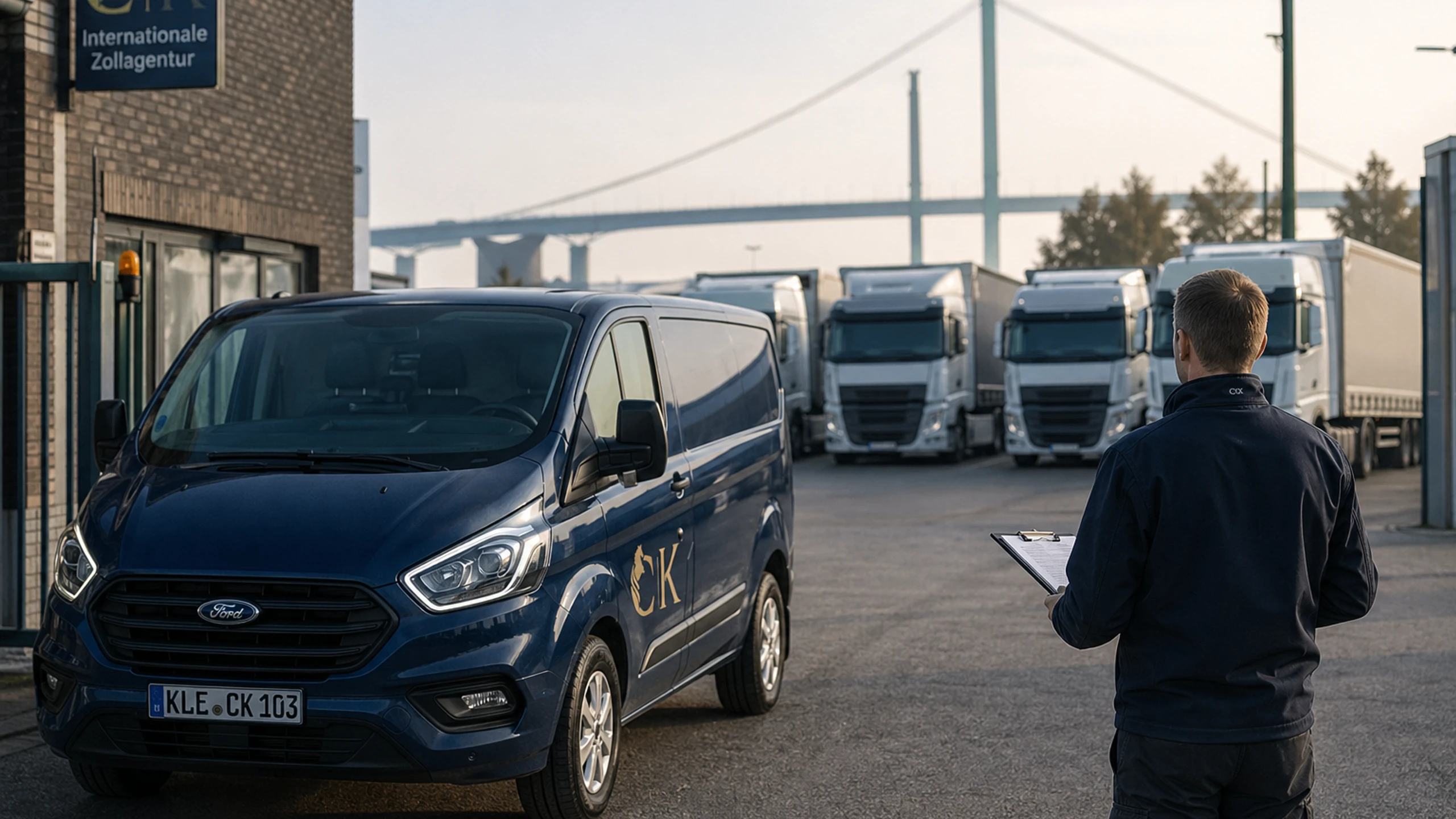
We open, monitor and discharge your transit movements in NCTS - T1 for non-Union goods, T2 for Union goods crossing third territories, and Common Transit in EFTA states. From Emmerich, we steer transits daily between Rotterdam, Antwerp and German inland customs offices. We post the security, hand your driver the TAD with MRN, and we monitor the discharge at the office of destination until the procedure closes out.
What you get from us
We open your transit declarations in NCTS, post the comprehensive or individual guarantee, watch the transit deadlines, and discharge the procedure at the office of destination. We act for you as declarant or holder of the procedure - or we run the procedure under your own authorisation. With our authorised consignor and authorised consignee status, we open and discharge transits at the premises, so your truck never has to detour to a customs office.
What we secure for you
Holder of the procedure - we carry the risk
We act in NCTS as holder of the procedure and carry the liability for proper discharge. If a confirmation does not come back, we open the enquiry procedure and supply alternative evidence so your security never gets called.
Authorised consignor and consignee at your premises
We open and discharge the procedure on site or at your warehouse - no truck has to detour to the customs office. Own seals instead of customs seals save time and dwell costs.
Comprehensive guarantee instead of single security
We post a running guarantee that covers several procedures in parallel. With AEO status, reductions to 50, 30 or 0 percent are possible - we set this up together with your main customs office.
T1 and ATLAS import in one hand
In the Rotterdam-Antwerp-to-Germany corridor we open the T1 at the port, discharge it at the German inland customs office and attach the ATLAS import declaration in the same flow - one data chain, one point of contact.
T1 / T2
Transit procedures for non-Union and Union goods
NCTS-P5
Active EU-wide since 2024/2025, harmonised EUCDM data sets
0-50 %
Security reduction possible with AEO status
1987
Common Transit Convention - EU + EFTA + UK + Turkey + others
How a transit movement with CK runs
01
Job clarification and guarantee
We clarify who acts as holder of the procedure - i.e. who is recorded in NCTS and liable for duties if anything goes wrong. We set the office of departure, office of destination, route and deadline, and we draw on either our comprehensive guarantee, your own authorisation or an individual guarantee. We lodge the security with the main customs office through our guarantor.
02
Data capture and NCTS declaration
We capture every mandatory EUCDM field: parties, item lines with CN code, quantity, value and packages, means of transport, route, seals, deadline and security. We transmit the declaration electronically into NCTS, and you receive the LRN/MRN back immediately. Under our authorised consignor status we open the procedure right at the premises - no presentation at the office of departure.
03
Transit Accompanying Document and movement
As soon as NCTS accepts the declaration, we print the Transit Accompanying Document (TAD) with MRN and barcode and hand it to your forwarder or driver. On the road, the MRN is scanned at every transit customs office; for sea and rail traffic this runs via structured messages. We document the seal numbers cleanly so nothing gets stuck at the office of destination.
04
Discharge at the office of destination
At the office of destination we present the consignment, have the seals checked and report the discharge in NCTS. Under our authorised consignee status we receive the consignment directly at your warehouse - with immediate posting in the warehouse records and notification to the office of destination. In the same flow we attach the import clearance (for T1) or the onward use as Union goods (for T2).
05
Monitoring and enquiry procedure
We actively monitor every MRN until the discharge message lands. If the confirmation does not come back, we open the enquiry procedure, gather alternative evidence - consignee receipt, stamps, freight documents - and stop your security from being called. If we find damaged or broken seals, we document the finding on arrival straight away.
“
Transit movements run across borders, ports and main customs offices. We keep the overview - even when the consignment is already in motion.
We open a T1 when your goods come from a third country and have not yet been released into free circulation - typically containers from the port of Rotterdam or Antwerp. We use T2 when Union goods are moved through a third country or outside the fiscal territory, for example from Germany via Switzerland to Italy. For pure EU intra-trade you do not need a transit procedure - we check that with you in the initial call.
The holder of the procedure - under the UCC: holder of the transit - is recorded in NCTS as responsible and is liable for proper discharge. If the procedure is not discharged, the goods count as unlawfully released into the economic circuit, and duty, import VAT and where applicable excise duty are levied against the security or directly against the holder. As a rule, we step in as the holder of the procedure ourselves and take that risk off your shoulders; alternatively we run your own authorisation.
NCTS Phase 5 is the current EU upgrade with harmonised EUCDM data sets. Structured quantity, value and party fields are mandatory, and the interfaces with ICS2 (security declaration) and AES (export) are more tightly integrated. The switchover ran EU-wide through 2024/2025, and old data templates get rejected. We work end to end in NCTS-P5 - you notice nothing of it except a clean declaration that goes through.
We use our own authorisations: as authorised consignor we open the procedure right at the premises - your goods don't need to be presented at the office of departure. As authorised consignee we receive your consignment at the warehouse - posting it in the warehouse records is enough. That saves waiting time at the customs office on every shipment and cuts dwell costs. On request we also walk you through applying for your own authorisation at the main customs office.
The security covers the potential import duties - duty, import VAT and where applicable excise duty. We post either our comprehensive guarantee, which secures several running procedures in parallel, or we set an individual guarantee per shipment. With AEO status we get reductions to 50, 30 or 0 percent. We line up the guarantee amount and the authorisation together with your main customs office and our guarantor.
If the transit deadline runs out without a discharge message, the office of departure opens an enquiry procedure. We react immediately and supply alternative evidence: consignee receipt, freight notes with stamps, warehouse records. If accepted, we discharge the procedure retrospectively; otherwise duty and import VAT would be levied against the security or the holder. Exactly for this reason we monitor every MRN actively - so it doesn't get to that point in the first place.
Yes, that is our standard case in the Rotterdam-Antwerp-to-Germany corridor. We open the T1 at the port, discharge it at the German inland customs office and attach the ATLAS import declaration in the same flow. You get one point of contact, one data chain and a reliable schedule - no break between the NL and DE procedures.